
The 2025 Kennedy Half Dollar in Today’s Market: Common Issue or Smart Buy
The 2025 Kennedy half dollar value is not a single number. The 2025 issue splits into four different collector markets. There are two business strikes, one clad proof and one silver proof. That changes the price structure right away. It also changes how collectors should buy the coin. A spent 2025-P is one thing. A silver proof is another. Here, let’s check how to treat them separately.
What Exists in 2025
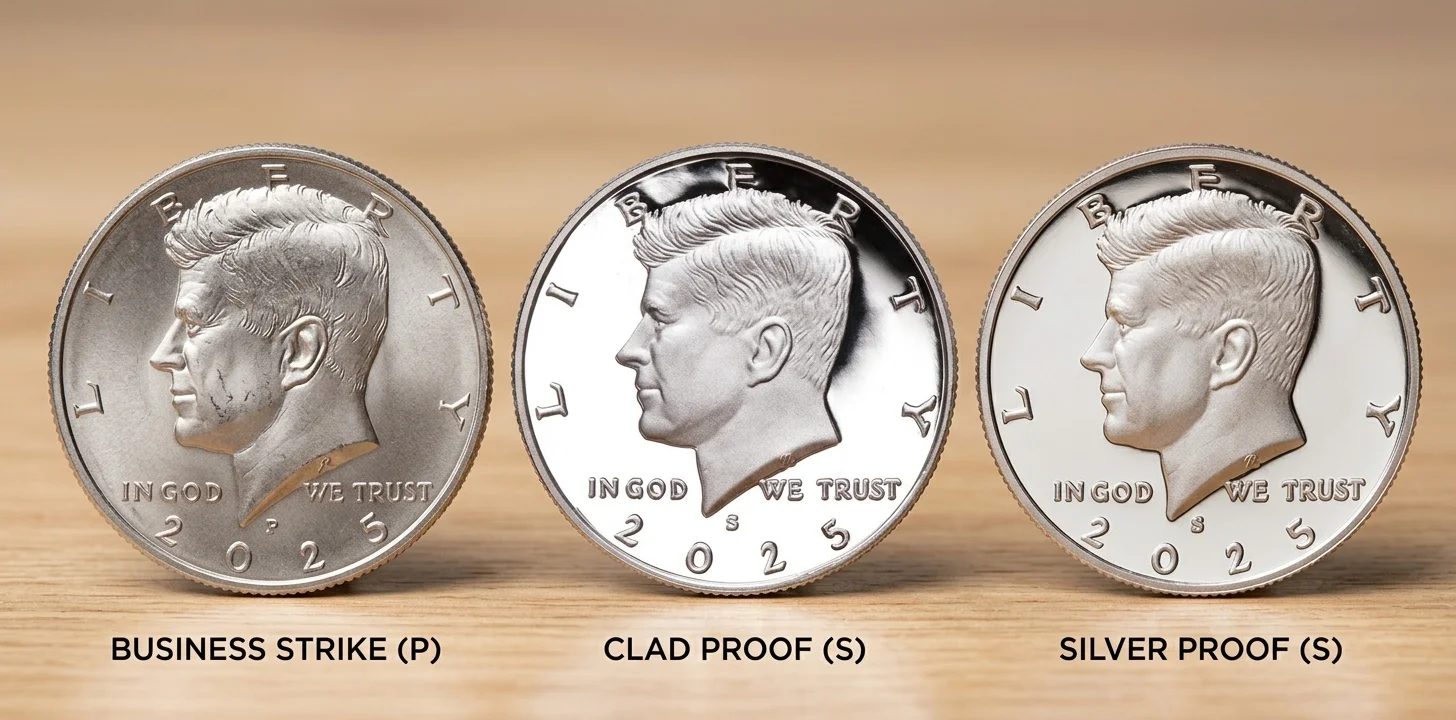
Before discussing value, we need to separate the versions of the 2025 half dollar. The U.S. Mint offered the circulation-style pieces in a 200-coin bag and a two-roll set.
The annual Uncirculated Set also includes one Kennedy half dollar from Philadelphia and one from Denver. The clad proof appears in the 2025 Proof Set. The silver proof appears in the 2025 Silver Proof Set, where the half dollar is struck in 99.9% fine silver.
2025 Kennedy half dollar versions
| Version | Finish | Composition | Main channel |
| 2025-P | Business strike | Clad | Bags, rolls, annual sets |
| 2025-D | Business strike | Clad | Bags, rolls, annual sets |
| 2025-S | Proof | Clad | Proof Set |
| 2025-S Silver | Proof | .999 silver | Silver Proof Set |
The table matters because each version has a different buyer. The P and D coins belong to the modern business-strike market. The clad proof belongs to the annual proof-set market. The silver proof sits in a higher bracket because it combines collector demand with precious metal content.
Why the Coin Feels Scarcer Than It Really Is
Many people rarely see recent Kennedy halves in change. That part is true. It does not make the coin rare by itself. The U.S. Mint states that, since 2002, half dollars have been minted primarily for annual coin sets and other numismatic products, though the Federal Reserve can still order them for circulation. That is why the coin feels scarce in daily life while staying available to collectors through official channels and the secondary market.
This point matters for beginners. “I never see it” and “it is rare” are not the same idea. The 2025 half dollar is better understood as a modern collector-distributed issue. That explains why many examples are still clean, why packaging matters, and why raw business strikes usually do not behave like true low-mintage keys.
Basic Specifications that Matter
The clad versions follow the normal modern Kennedy half dollar format: the clad composition at 91.67% copper and 8.33% nickel, with a diameter of 30.6 mm and a weight of 11.34 grams.
The 2025 Uncirculated Set also gives the half dollar at 11.340 grams and 30.61 mm, with a reeded edge. The silver proof keeps the same diameter but moves to 99.9% fine silver and a higher weight.
Main specs
| Version group | Diameter | Weight | Edge |
| Clad business strikes / clad proof | 30.6 mm | 11.34 g | Reeded |
| Silver proof | 30.6 mm | heavier than clad | Reeded |
This is not a long technical section, but it helps in real collecting. A modern half dollar should be checked as a version first. The year alone is not enough. The same date exists in more than one finish, more than one market, and more than one price band.
A practical coin identifier can help at the first step. Coin ID Scanner is useful when you want a quick version check before you compare surfaces and packaging. Its Smart Filters and AI assistant can shorten the first pass through similar-looking modern halves. That said, no app replaces direct inspection. The final call still comes from the coin in hand.
The Real Market Split
The market for the 2025 half dollar is easier to read if you divide it into four tracks.
Track 1: 2025-P and 2025-D business strikes
These are the most ordinary versions. They were sold in bulk products and annual sets. In raw form, they usually stay close to face value or carry only a small premium unless the coin is clearly uncirculated and attractive.
Greysheet’s current 2025 business-strike page places the two entries in a broad range from $0.50 to $25.00, which shows how much the top of the market depends on condition rather than date alone. USA Coin Book gives both the 2025-P and 2025-D a baseline of $2.50 or more in uncirculated mint condition.
Track 2: 2025-S clad proof
This coin belongs to a different group. It was struck for the Proof Set. It has the usual proof appeal: sharper presentation, mirrored fields, and collector packaging. USA Coin Book places the 2025-S clad proof at $6.26 or more.
Greysheet’s 2025 proof page shows two proof entries with values between $12 and $140, which reflects the stronger role of grade and proof quality in that market.
Track 3: 2025-S silver proof
This is the strongest issue of the year. The U.S. Mint describes the half dollar in the Silver Proof Set as 99.9% fine silver. USA Coin Book gives it a value of $41 or more and shows a melt value of $29.73 on the current page. That built-in metal floor is important. It means the silver proof does not rely on collector demand alone.
Approximate Market Ranges
| Version | Typical market level | Why it stays there |
| 2025-P / 2025-D spent coin | about 50¢ to small premium | common modern business strike |
| 2025-P / 2025-D fresh raw coin | about $2.50 and up | uncirculated quality matters |
| 2025-S clad proof | about $6 and up | proof finish, set demand |
| 2025-S silver proof | about $41 and up | silver content plus proof demand |
These are not rigid numbers. They are working market ranges built from current guide levels. The shape of the market is more important than the exact dollar. Raw P and D coins stay modest. Proofs move higher. Silver proofs stand above the rest because they combine finish, packaging, and metal value.
Condition Is the Main Driver
For the business strikes, grade does most of the work. A worn 2025 half dollar is just a modern half dollar. A bright raw coin from a Mint roll is better, but still common. The stronger premium begins when the coin is cleaner than average and stays that way under close inspection.
Business strikes better than MS66 or MS67 are largely treated as conditional rarities. That does not mean every nice 2025-P or 2025-D is special. It means the real jump comes late.
What should you look for on the coin itself?
- Clean fields
- Fewer contact marks
- Stronger luster
- No obvious rim damage
- A sharper overall look
Modern coins pick up hits fast. Kennedy’s portrait shows them fast as well. That is why many raw business strikes remain cheap while a clearly better coin stands out.
For proofs, the rules change a little. The buyer expects mirrored fields, sharp contrast, and better preservation. Hairlines, haze, or weak presentation hurt the coin more here than on a normal roll coin. The silver proof has one extra support point: even if collector demand cools, the silver content still gives the coin a floor that clad proofs do not have.
Common Issue Or Smart Buy?
The answer depends on the version.
If the question is about the 2025-P or 2025-D in ordinary raw form, the coin is still a common issue. It is modern. It was sold directly by the Mint in bags and rolls. It appears in the annual set. Guide levels for normal uncirculated pieces remain low. That is not a bad thing. It just means the buyer should stay disciplined.
If the question is about the silver proof, the answer changes. That version has the clearest case as a smart buy inside the year. It has a stronger finish, a collector-only format, and silver content. It is not a hidden rarity, but it has the best built-in support. The clad proof also makes sense for collectors building annual proof runs, though its premium is smaller.
Practical Buying Advice
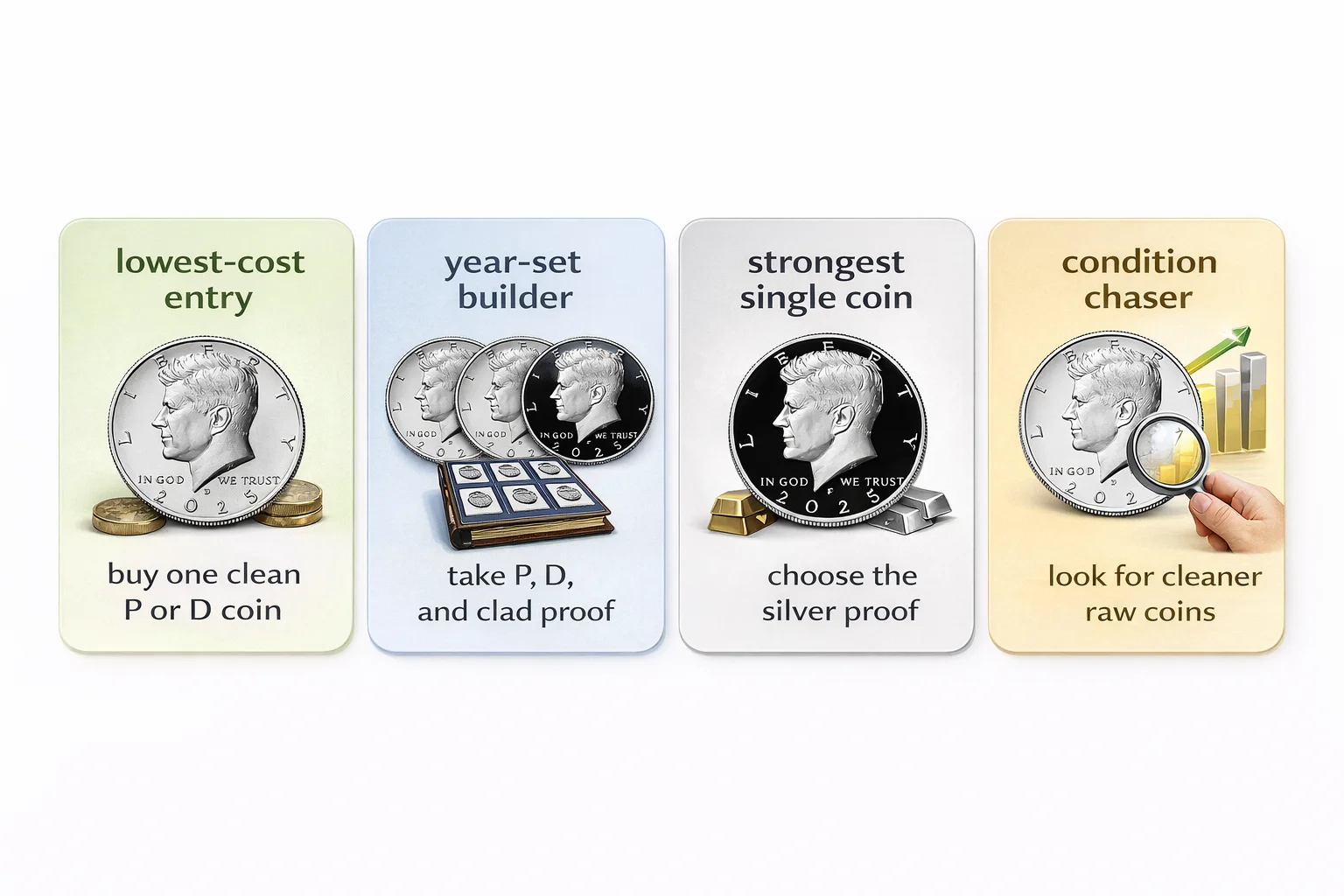
A practical strategy depends on what kind of collector you are.
If you want the lowest-cost entry:
Buy one clean P or D coin. Do not overpay for an average raw piece.
If you build year sets:
Take the P, the D, and the clad proof. That gives the date a fuller representation.
If you want the strongest single 2025 coin:
Choose the silver proof. It has the best structure in the market today.
If you chase the condition:
Look for cleaner raw examples from Mint rolls or certified coins that are clearly above average. The guide structure shows that grade matters more than the date itself.
What about Hype and Errors?
Fresh dates often collect hype fast. The safer approach is simple: value the coin by version first, then by grade. Mainstream references for 2025 are centered on the standard four-version structure: P, D, clad proof, and silver proof. That tells you where the real market is today. It is better to buy a strong, known format than to pay up for weak claims around a new coin.
Conclusion
The 2025 Kennedy half dollar is common in one sense and smart in another. The P and D coins are common modern issues unless the condition becomes exceptional. The clad proof is a steady collector coin. The silver proof is the strongest issue of the year because it combines proof quality with 99.9% silver. That is the cleanest way to read the market.If you are a newcomer, begin with the best coin identifier app free to search before buying. That is fine as a starting point. The better result comes from a simple order: identify the version, check the surface, compare the real market range, and buy the coin that fits your set. For this date, the right version matters more than the year alone.